OTIF (On Time In Full) is a key metric for many businesses. It measures how many promises you have kept with your customers.
Poor OTIF bring lots of hassles and problems; under utilisation, angry customers, complicated scheduling etc…
Everyone I come across in business understands intuitively that good on time delivery is a basic performance goal for any organisation.
So, why do so many businesses struggle with their OTIF performance?
You need to keep your performance in your sights
It is easier to bury your head in the sand when your performance isn’t in the right place.
You hope the affected customers have someone else (worse) to chase.
You pray that your teams can keep to the (revised) schedule.
And, after all, no news is good news… isn’t it?
No, this is a rubbish strategy to get better and have an easier life.
Keep OTIF in your eye line
Like many other things, if you keep something in your eye line you have a better chance of doing something positive with it, hopefully achieving the results you want.
When you keep looking at something, focusing on it, and it is important, you notice that you take different actions. If the goal is buried in a document somewhere, this is less likely to happen.
So, keeping your OTIF score, and your OTIF improvement plans, in your daily eye line is a key strategy for most people that need to improve.
Remember, what gets measured gets managed and seeing the measurement regularly can help you to manage more effectively.
What if you don’t like the score?
And this is the key. You don’t have to like it. You don’t have to give it meaning.
You just need the score so that you can make decisions on what you want to do differently.
At one point in time Arnold Schwarzenegger wasn’t happy with his calves. He cut all his tracksuit bottoms off so he had to expose his lower legs. He kept his issue in his eyeline until he got them sorted. Based on his trophy cabinet, it looks like it worked for him too.
Let the score be the score and allow it to be a guide. Just make sure that you use the information it gives you.
An example to consider
Years ago I worked in a production team where the department head didn’t like the OTIF number, he avoided reality.
I’d taken the Production Manager role and couldn’t figure out initially why I had so many frustrated customers on the phone when our on time delivery score was so good.
My boss made up the number. Every month. For years. I’m pleased he was honest with me about that!
When we decided to do something about this situation everyone was up in arms. We shared the real OTIF score and they argued that we weren’t that bad. They wanted to keep the number a secret, but once we started to embrace that number we started to make some different decisions.
We did things differently, consistently, logically. We looked at our metric every day. We created related metrics, that helped us drive the OTIF score.
Within a few weeks our scores started to climb.
Life got easier and, long story short, we became one of the best deliverers of our product globally. It was a game changer for our customers, our profits and our sanity.
Can you get your OTIF score into your eyeline?
Can you do something similar?
Can you get your OTIF plans into your daily discussions?
Can you get your score somewhere visible, where it can spark discussion?
Can you help your teams to generate ideas that would help improve your delivery performance?
Can you take one next step forward?
Keeping something important, like OTIF performance, in your sights until you have reached a good, consistent, performance is a great strategy.
You might start off not liking the score’s value, but after a while, with a little bit of focus and persistence, you might grow to like your score. And, when your customers start to like it, and your profits reflect this, you’ll know that you have achieved your goal.
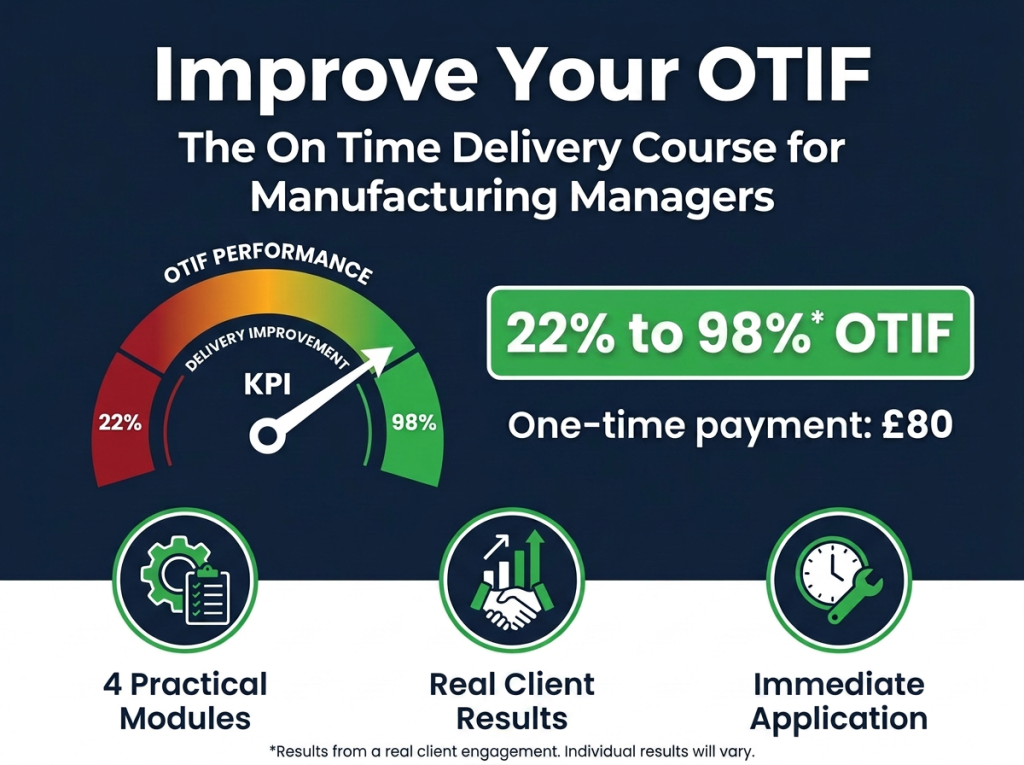
If you want some additional ideas to improve your OTIF performance, then don’t forget to check out The On Time Delivery Course.